The Grade 5 request returns 202
Both API origins returned ready operations, opaque 404s across tenants, complete 52-item coverage, and request-correlated 12 CASE plus 8 Content 2xx calls. No local stand-in was credited.
Blueprint · Integrator API · mastery_gate · attempt 9
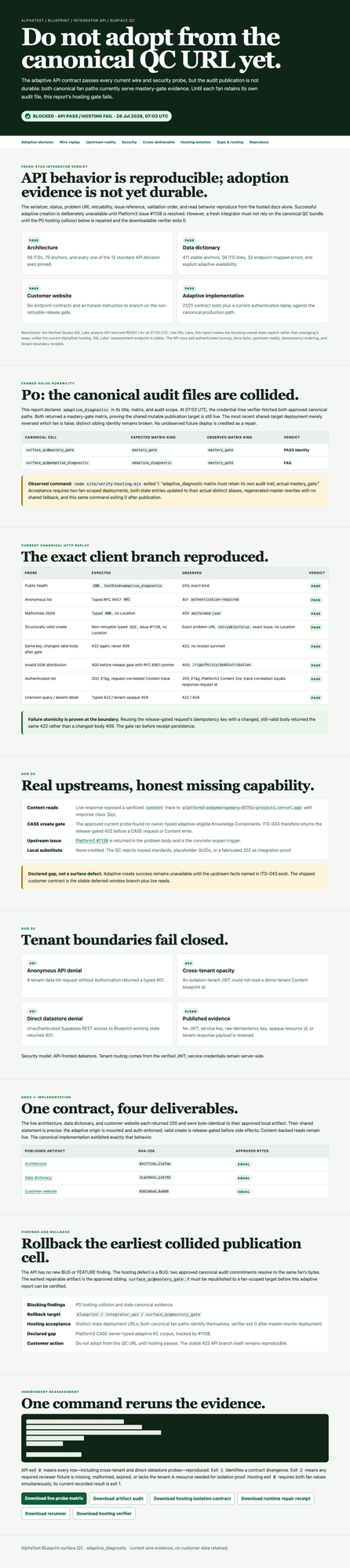
A fresh 19-check rerun proves the documented Grade 5 create, tenant isolation, datastore boundary, and real CASE/Content calls on both API origins. Publication is split across attempt-7 and attempt-8 mastery bytes, and the adaptive canonical path serves mastery; the engine still cannot preserve both fan identities.
Fresh-eyes integrator decision
The AcmeTest maintainer’s tech lead can replay the full API pass and the publication blocker without source access. Exit 0 from both scripts unlocks adoption; any non-zero result blocks it.
Both API origins returned ready operations, opaque 404s across tenants, complete 52-item coverage, and request-correlated 12 CASE plus 8 Content 2xx calls. No local stand-in was credited.
The fan deployment succeeded, but its stable alias remains on attempt 7. The engine probes the protected deployment-hash URL, receives 302, only knows how to remediate 401, then discards the deploy before state and canonical rewrites advance.
Endpoint evidence
The credentialed rerunner uses new idempotency keys and retains no credential, request body, opaque resource id, or tenant payload.
| Check | Canonical | Immutable | Evidence |
|---|---|---|---|
| Health | 200 | 200 | mastery_gate; ready |
| Anonymous list | 401 | 401 | Typed authentication-required |
| Authorized list | 200 | 200 | Current Content 2xx trace on each origin |
| Exact documented create | 202 | 202 | Ready; Location shape; 12 CASE 2xx + 8 Content 2xx each |
| Idempotency | 202 / 409 | 202 / 409 | Replay header true; changed body rejected |
| Detail + exhaustive coverage | PASS | PASS | 20 rows; 9 standards; 52 items; ≥ DOK; target 100 |
| Cross-tenant reads | 404 / 404 | 404 / 404 | Operation and blueprint existence both opaque |
| Cross-tenant create | 422 | Current isolation-tenant request had no Location and no write | |
| Direct datastore | 401 | Current unauthenticated Supabase REST request denied | |
| Dedicated mastery report + downloads | STALE | alphatest-blueprint-qc-mastery-gate.vercel.app; 200 with attempt-7 mastery bytes | |
| Canonical QC identities | EXIT 1 | Primary is attempt 8; dedicated and master mastery are attempt 7; adaptive incorrectly serves attempt-8 mastery report, matrix, and audit | |
DoD D2 + D5
Both deployments deny anonymous tenant-data lists.
Both operation and blueprint existence remain opaque on both origins.
Unauthenticated Supabase REST is denied.
Each create carries 12 CASE and 8 Content 2xx traces naming the declared Platform3 host.
No mock or local fixture is credited as upstream proof. API-fronted datastore; server credentials are not published. Current tenant isolation and the direct anonymous datastore boundary are both proven at the deployed edge.
Severity-ranked findings
Observed: the credential-free node verify-hosting.mjs exited 1 at 17:35:54 UTC. The shared primary alias served attempt-8 mastery bytes, while the dedicated mastery origin and master’s mastery fan path served attempt-7 mastery bytes; the adaptive fan path served attempt-8 mastery identities. Redeployment cannot preserve both fan values simultaneously.
Root cause: the successful fan deploy is followed by an HTTP check against its Vercel deployment-hash URL. The previous reviewer captured a 302 SSO redirect there at 12:35:32 UTC. The engine helper ensure_vercel_public_if_401 remediates only status 401, so 302 reaches deploy_to_vercel as non-200. The engine exits before patching summary.json/state or regenerating the canonical master rewrite. Another artifact rebuild or plain driver redeploy cannot close this defect.
Fix: repair the loop engine to recognize Vercel SSO 302/303 as protection and disable it before rechecking, or perform the post-deploy 200 check against the public stable project alias. Then rerun the driver, require state to record the fan deployment, regenerate master rewrites, and require the unmodified canonical verifier to exit 0 with exact report/matrix/audit byte matches on both mastery origins.
Triage: BUG in the post-doer publication runtime, outside the architecture → integration cell grid. No approved architecture, dictionary, website, API behavior, or surface-QC bytes must roll back. This is customer-visible wrong content, not only a stalled build, and it taints either fan after the next redeploy. Watchdog evidence contains exactly 21 unique mastery-gate 302 failures in the bounded 06:58:31–15:44:10 UTC window; reviewers recorded the 23rd occurrence during attempt 6’s driver deploy at 16:19:18 UTC and the 24th during attempt 7’s driver deploy at 17:03:39 UTC. The watchdog livelock guard must now notify, mark the cell escalated, park it instead of scheduling another content rebuild, and guard other publication-dependent work from the same engine failure.
Cross-deliverable QC
| Deliverable | Verdict | Evidence |
|---|---|---|
| Architecture | PASS | Approved bytes; 56 ITDs; all 12 API axes pinned. |
| Data dictionary | PASS | Approved hash; route and field contract agree. |
| Customer website | PASS | Approved hash; exact Grade 5 example agrees. |
| Implementation@mastery_gate | PASS | Fresh attempt-9 19/19 rerun: exact create, idempotency, coverage, auth, isolation, datastore, and real upstream traces. |
| Surface-QC publication | GATED | No origin serves attempt-9 yet; the current three-origin split proves the engine still cannot publish mastery without corrupting or staling a sibling. |
Write granularity, read shape, query model, concurrency, idempotency, auth shape, eventing, error envelope, tenant routing, conformance evidence, privacy/retention, and list endpoints map to active ITDs in the downloadable audit.
Independent reassessment
The hosting verifier is a single file: its attempt-9 report, matrix, and audit hashes are embedded, so it does not read any companion file. It has no URL override and proves whether primary mastery, mastery fan, and adaptive fan identities are simultaneously correct. The API script exits 2 rather than guessing when reviewer fixtures are unavailable.
qc_tmp="$(mktemp -d)"
curl -fsSLo "$qc_tmp/verify-hosting.mjs" \
  'https://alphatest-blueprint-qc.vercel.app/verify-hosting.mjs'
node "$qc_tmp/verify-hosting.mjs"
# Current baseline: exit 1; required after engine repair: exit 0

curl -fsSLo "$qc_tmp/probe.mjs" \
  'https://alphatest-blueprint-qc.vercel.app/probe.mjs'
: "${BLUEPRINT_PROD_REVIEWER_JWT:?fresh demo reviewer JWT required}"
: "${BLUEPRINT_ISOLATION_REVIEWER_JWT:?fresh isolation JWT required}"
: "${SUPABASE_URL:?public Supabase project URL required}"
node "$qc_tmp/probe.mjs"
# Current baseline: exit 0; any non-zero result blocks adoptionRepair routing
ensure_vercel_public_if_401 to treat Vercel SSO 302/303 as protection, or verify the public stable alias.Benchmark
Qualys SSL Labs’ analyze API was fetched live during this attempt at 17:34 UTC and returned HTTP 200, READY, endpoint grade A+, engine 2.4.2. This report follows its fail-closed overall-state discipline and adds auth, tenant, upstream, documentation-byte, canonical-publication, and repair-routing receipts.